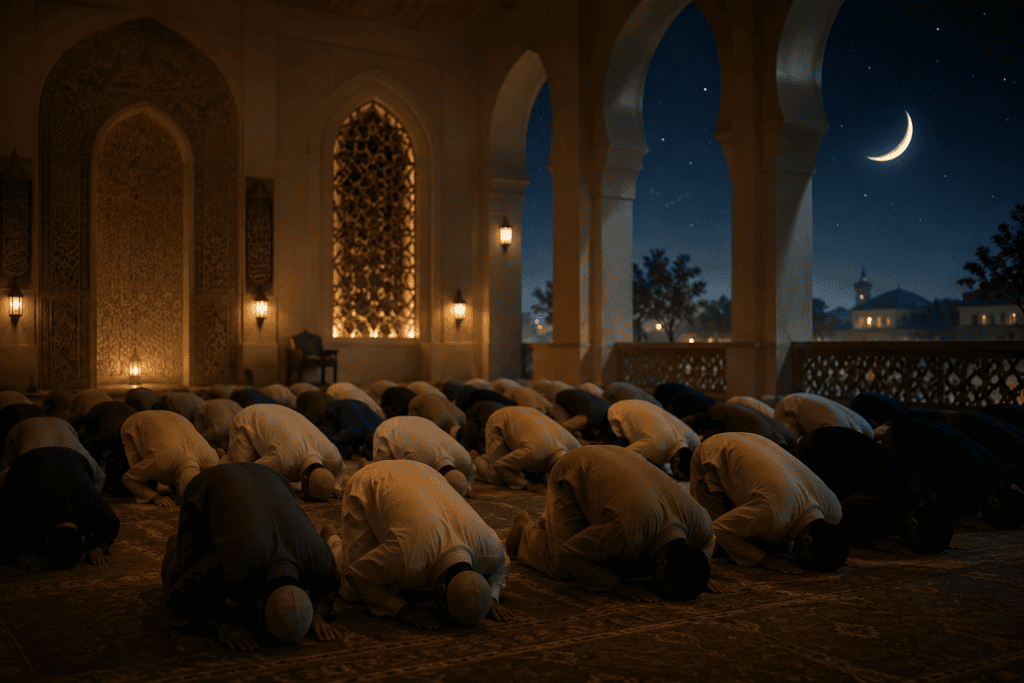
Every night of Ramadan, mosques fill up after Isha for a prayer that doesn’t exist the rest of the year in quite the same way. If you’ve ever wondered where Tarawih actually comes from, whether it’s obligatory, or how to get more out of it than just standing and sitting — here’s the simple version, sourced properly.
What the Prophet ﷺ Actually Said About It
The core virtue of Tarawih comes from one clear hadith: whoever stands in prayer during Ramadan out of genuine faith and sincerely seeking reward will have their previous sins forgiven (Sahih al-Bukhari 2009, agreed upon in meaning with Sahih Muslim). Notice the two conditions built into that sentence — faith, and sincerely seeking reward. It’s not the standing itself that carries the weight; it’s the state of the heart behind it, echoing exactly what we discussed about intentions.
Is It Obligatory?
No — and this is worth knowing plainly. Tarawih is a strongly encouraged sunnah, not a fard (obligation) like the five daily prayers. The Prophet ﷺ himself prayed it in congregation a few nights, then stopped leading it in the mosque specifically because he was concerned it might become seen as obligatory upon his followers if he continued nightly (this concern itself is recorded in the hadith literature around this practice). That’s a meaningful detail — even the Prophet ﷺ was careful not to over-burden the ummah with something not required.
How It Became a Regular Congregational Practice
After the Prophet ﷺ passed away, people prayed Tarawih individually or in small scattered groups for a time. It was Umar ibn al-Khattab, the second Caliph, who saw people praying separately one night and organized them behind a single reciter, remarking that this was a excellent innovation (in the sense of a good, beneficial new practice, not a religious innovation in the negative sense) since it brought the community together for something so good. This history matters because it shows Tarawih’s congregational form was a practical, welcomed organizational choice — not something altered from what the Prophet ﷺ taught about the prayer’s core virtue.
How Many Rak’ahs?
This is one of the few points where there’s genuine, longstanding difference among sober scholarship — some pray 8, others 20, and there are historical precedents for both, plus some other variations. Rather than presenting one as definitively correct, it’s worth simply following whatever your local mosque or community practices, since this is a matter of established scholarly latitude, not a point requiring you to personally adjudicate between schools of thought.
Getting More Out of It
A few simple things make a real difference in how present you actually are during Tarawih:
- Understand roughly what’s being recited. Even a rough idea of the surah or its general theme, checked beforehand, changes how you experience the prayer compared to standing through unfamiliar sound.
- Don’t treat it as a race to the end. The reward described in the hadith is tied to sincere faith and seeking reward — rushing through it mentally checked-out works against exactly that.
- It’s fine to need breaks or shorter nights sometimes. Consistency across the month matters more than a single perfect night followed by burnout.
A Note Before You Go
The exact number of rak’ahs and specific regional practices around Tarawih vary in ways this article intentionally didn’t try to settle, since it’s a matter of legitimate scholarly difference rather than a single fixed answer. If you’re new to a community’s specific practice, simply following your local mosque’s approach is a reasonable, well-supported choice.